Quick answer
What is customer feedback management?
CFM is how a business turns customer feedback into improvements: it collects feedback, analyses it and uses it to improve products, services and the customer experience. Feedback management software usually does the capturing and processing, helping teams spot recurring issues, measure sentiment, respond to customer needs and build trust.
In this article (11 sections)
- Why Is Customer Feedback Management Important?
- Benefits of Customer Feedback Management
- How to Manage Customer Feedback?
- Key Components of Customer Feedback Management
- Best Practices for Effective Customer Feedback Management
- What Is a Feedback Management System?
- How AI Is Used in Customer Feedback Analysis
- How to Monitor and Refine the Feedback Management Process
- Customer Feedback Management Examples
- Conclusion
- Frequently Asked Questions
This guide sets out customer feedback management (CFM) as a working framework: the components every feedback programme needs, the steps to run it, the software that supports it, how AI helps with analysis, and how to keep improving the process once it is running.
Why Is Customer Feedback Management Important?
Most businesses already receive feedback: survey answers, reviews, complaints at the counter, comments on social media. Without a process, it stays scattered across channels and teams, urgent complaints wait in inboxes, and the same problems come back because nobody owns them. A customer feedback management process gives every piece of feedback a route: it is captured, sorted, analysed, assigned to someone who acts on it, and closed with the customer.
The result is a business that listens actively rather than occasionally. Recurring issues are spotted and fixed at the source, changes in customer sentiment are measured rather than guessed, and customers who see their concerns addressed are more likely to stay and to trust the brand.
Benefits of Customer Feedback Management
A well-run CFM process delivers:
- A better customer experience, because pain points in the customer journey are found and fixed.
- Higher satisfaction and loyalty, as customers see their input lead to visible changes.
- Better decisions on products, services and priorities, based on evidence rather than assumptions.
- Early warning of trends and issues, before they turn into bigger problems.
- Ideas for innovation, from needs customers mention that you had not considered.
- Stronger relationships, because regular, two-way contact shows customers their opinions matter.
For the full business case, with how feedback affects revenue, loyalty and product planning, see why customer feedback is important.
How to Manage Customer Feedback?
Managing customer feedback comes down to five steps, repeated continuously:
- Define clear objectives: decide what feedback should help you achieve, such as improving satisfaction with a service or evaluating a new product.
- Choose the right feedback channels: surveys, reviews, feedback forms, QR codes or direct conversations, depending on where your customers are. Our guide to online feedback systems covers the digital channels.
- Analyse and interpret the data: identify key trends, recurring issues and changes in sentiment.
- Take action on insights: assign each issue to the team that owns it and implement changes.
- Communicate back to customers: tell them what was done in response to their feedback.
Key Components of Customer Feedback Management
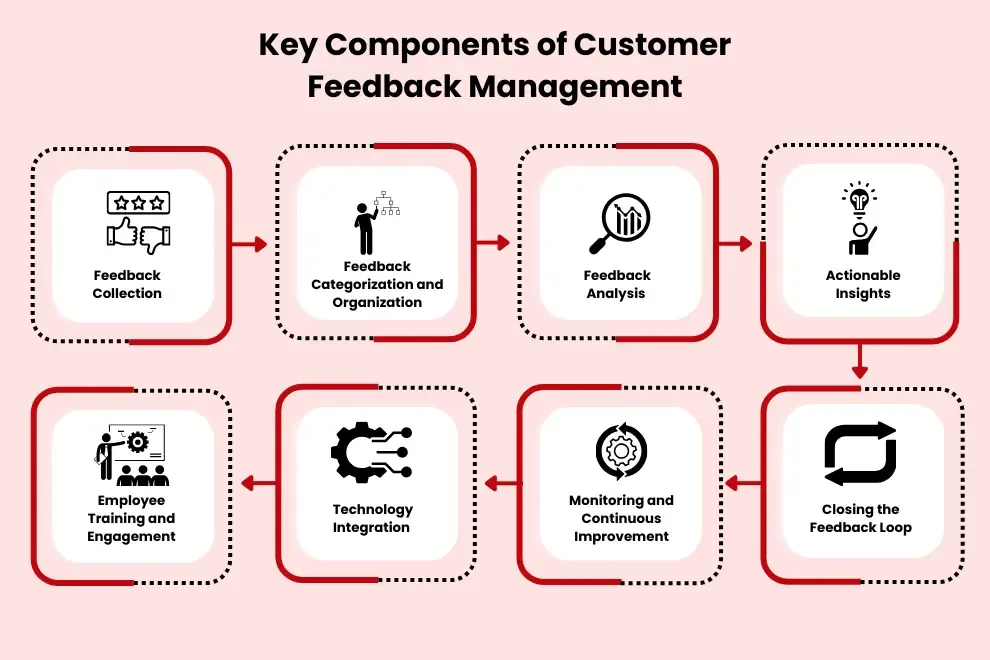
Behind those steps sit eight components that a complete CFM programme needs:
1. Feedback Collection
The foundation of CFM is gathering input through channels such as surveys, social media, online reviews, chatbots, email and on-site forms. Different customer groups respond to different methods: email surveys may work for one group, while a QR code at the point of service suits another. Keep questions clear and focused on what you can act on.
2. Feedback Categorization and Organization
Not all feedback carries the same weight or urgency. Sorting it into categories such as service quality, product performance or customer support, and separating critical complaints from suggestions and compliments, lets teams deal with the most pressing concerns first and allocate resources where they matter. A complaint about a safety issue, for example, should not wait in the same queue as a suggestion about the colour of a menu.
3. Feedback Analysis
Analysis groups feedback into themes, identifies patterns and uncovers pain points or preferences. It can be done by manual categorisation, sentiment analysis or AI-driven software. Recurring complaints about slow delivery, for example, point to an operational fix.
4. Actionable Insights
Feedback is only valuable if it leads to action. Action planning turns insights into specific changes, often across departments. If customers frequently ask for more payment options, the action might be integrating additional payment gateways, which needs operations and finance as well as customer support.
5. Closing the Feedback Loop
Closing the loop means telling customers what changed because of their feedback. If a customer suggests a feature and it is implemented, tell them by email, a social media announcement or a direct reply. This step is often overlooked, yet it builds trust and encourages customers to keep giving feedback.
6. Monitoring and Continuous Improvement
Customer preferences and market conditions change, so CFM should be an ongoing process. Monitoring the effect of each change and regularly seeking new feedback keeps the business aligned with customer expectations. Regular audits, feedback cycles and metrics such as Net Promoter Score (NPS) show whether changes worked and where new problems are appearing.
7. Technology Integration
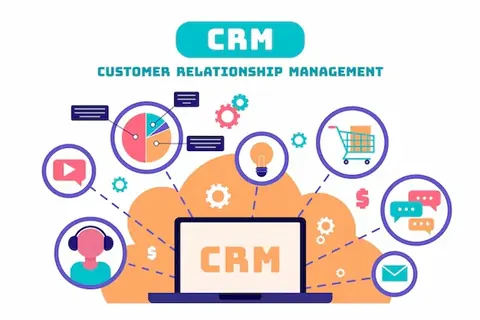
CRM software, survey platforms and analytics tools make the process scale. A CRM can centralise feedback alongside customer records, while analytics tools provide real-time insights and helpdesk tools manage replies to customers. Choosing technology that fits your volumes and channels keeps the process efficient as feedback grows.
8. Employee Training and Engagement
Staff need the skills to handle feedback well: active listening, empathetic communication and conflict resolution. Teams that are trained and empowered to resolve issues on the spot can turn negative experiences into positive outcomes and reinforce customer loyalty.
Best Practices for Effective Customer Feedback Management
- Offer several feedback channels, such as online surveys, social media polls and in-person forms. Customers who never open an email survey may happily answer a two-question form at the counter, so a mix of channels captures a wider range of opinions.
- Automate collection with feedback management software, so requests go out at the right moment, such as straight after a purchase or service visit, and no input is missed.
- Prioritise by impact: focus first on feedback that affects the most customers or the most important parts of the experience, such as resolving a recurring service failure before polishing a minor feature.
- Build feedback into continuous improvement rather than treating it as a one-off exercise. Review it on a fixed schedule, for example monthly for operational issues and quarterly for strategy.
- Engage customers regularly, asking for feedback at different stages of their relationship with you, from first purchase to renewal, so you understand how their needs evolve.
What Is a Feedback Management System?
A feedback management system (FMS) is the software that runs the customer feedback management process. It works as a central hub: feedback from surveys, reviews, social media, emails and direct interactions lands in one place, where teams can organise it, analyse it and act on it. Many systems also handle feedback from employees and other stakeholders across many locations, which is the focus of enterprise feedback management software.
Customer Feedback Management vs Feedback Management System
The two terms are closely related, but they describe different things:
| Aspect | Customer feedback management (CFM) | Feedback management system (FMS) |
|---|---|---|
| What it is | The practice of collecting, analyzing and acting on customer feedback | The tool or platform used to carry out that practice efficiently |
| What it includes | Goals, feedback channels, analysis, action, closing the loop and monitoring | Multi-channel collection, central storage, analytics, alerts and reporting |
| Example | A restaurant chain deciding to change staffing after customers complain about wait times | The surveys and reports that surfaced the wait-time complaints |
How a Feedback Management System Works
- Collect: it gathers feedback from the channels customers use, such as surveys, review platforms, social media, email, live chat and feedback forms.
- Organize: it sorts each response by type (complaint, suggestion, compliment), by channel and by customer group, and stores everything centrally.
- Analyze: it finds patterns and trends, often using sentiment analysis to separate positive, neutral and negative feedback.
- Alert: it flags urgent feedback, such as a negative review or a service complaint, so the right team can respond straight away.
- Report: it produces regular reports that show how customer satisfaction is changing over time.
- Close the loop: it helps teams reply to customers and tell them what changed because of their feedback.
Key Features of a Feedback Management System
- Multi-channel collection, so feedback from every touchpoint ends up in one place.
- Customizable feedback forms that can be sent by email, embedded on a website, used in an app or opened from a QR code.
- Categorization by feedback type, channel and customer segment.
- Sentiment analysis to help decide which responses need attention first.
- Real-time alerts that notify the responsible team about urgent concerns before they escalate.
- Integration with your CRM and other tools, and trend reports that track satisfaction over time.
To compare specific products, from free form builders to dedicated platforms, see our guide to customer feedback management tools.
How AI Is Used in Customer Feedback Analysis
Analysing feedback by hand works when volumes are small. As responses grow, manual review becomes slow, misses insights and is open to personal bias in how comments are read. AI-based feedback analysis addresses these limits:
- Sentiment analysis: natural language processing (NLP) classifies comments as positive, neutral or negative and picks up the emotion behind them, so issues that hurt satisfaction can be prioritized.
- Theme extraction: AI pulls key topics and recurring phrases out of open-text answers, reviews and social media mentions. A feature that keeps appearing in positive reviews, for example, is likely a strong selling point.
- Voice analysis: customer calls can be transcribed and analyzed in the same way as written feedback.
- Summaries: AI can condense large volumes of feedback into short summaries that product and service teams can act on.
- Predictive insights: historical feedback can highlight churn risks and shifts in customer preferences.
- Speed and scale: thousands of survey responses or social media mentions can be processed far faster than by manual review, so teams spend their time acting on insights rather than sorting data.
Challenges of AI Feedback Analysis
AI analysis also needs care. Customer data must be kept secure, and customers should know how their feedback is used and give their consent. Adopting AI tools involves upfront costs for the software, staff training and integration with existing workflows. Detailed sentiment breakdowns and predictive reports can also be hard to interpret for teams without technical expertise, so choose tools that present results simply and train the people who will use them.
How to Monitor and Refine the Feedback Management Process
Once the process is running, check regularly that it is producing results and adjust it as customer expectations change.
- Set measurable goals. Tie the process to targets you can track, such as higher ratings or shorter response times.
- Track satisfaction metrics. Use Net Promoter Score (NPS) and customer satisfaction (CSAT) surveys to see whether changes are working.
- Measure each initiative. Check whether a change improved feedback on that area, and adjust strategy as new trends emerge.
- Acknowledge feedback quickly. Reply promptly even when a fix will take time. Automated acknowledgements help make sure no feedback goes unanswered.
- Segment feedback. Group it by factors such as demographics, purchase history or behavior to see how the needs of different customer groups differ. High-value customers, for example, may need tailored solutions.
- Be transparent. Tell customers how their feedback will be used. People give more honest feedback when they know it leads to action.
- Build a feedback culture inside the organization. Encourage employees and management to take part in the feedback process too.
Customer Feedback Management Examples
Here is how the process looks in practice:
- Improving service: a restaurant chain uses customer surveys to measure satisfaction, finds problems with wait times and adjusts staffing levels.
- Refining a product: a software company receives feedback that its interface is confusing and simplifies navigation in the next update, which leads to better user reviews.
- Training staff: a retail store gathers feedback about staff interactions and uses it in training to improve the customer experience.
LazyMonkey's customer feedback management software is one example of a system built around this process: customers give feedback by scanning a QR code with no app to install, urgent issues are escalated to the right person, and real-time dashboards show results across locations.
Conclusion
Customer feedback management works when it is treated as a continuous cycle with clear owners: collect feedback where customers are, analyse it, act on it, close the loop and measure the result. Software makes that cycle faster and easier to scale, but the process comes first.
Frequently Asked Questions
What Is Customer Feedback Management?
Customer feedback management (CFM) is the process of collecting, analyzing, and using feedback from customers to improve a business.
Why Is Customer Feedback Important?
Customer feedback helps businesses understand their customers’ needs, preferences, and pain points.
How Can Businesses Collect Customer Feedback?
Businesses can collect feedback through surveys, customer reviews, social media, direct interviews, and support tickets
How Often Should Businesses Gather Customer Feedback?
It depends on the business type, but regular feedback after major updates, purchases, or service interactions is recommended.
What Is the Purpose of a Feedback Management System?
A feedback management system brings feedback from customers, and often from employees or other stakeholders, into one place so it can be organized, analyzed and acted on. It helps businesses resolve issues faster, spot trends and close the loop with customers.
How Does AI Help Analyze Customer Feedback?
AI uses natural language processing to sort feedback by sentiment, pull out recurring themes from text and call transcripts, and summarize large volumes of responses quickly. This lets teams see what matters most and act on it sooner.
Can AI Analyze Customer Feedback in Multiple Languages?
Yes. AI tools can analyze feedback written in multiple languages, which is useful for businesses whose customers do not all use the same language.
Filed under Feedback Management · First published