Quick answer
What should a pediatric care feedback form include?
A pediatric care feedback template collects parents' views on their child's care and should cover these areas:
- Quality of medical care
- Communication with parents
- Empathy and emotional support
- Cleanliness and child-friendly environment
- Timeliness and waiting times
- Overall experience and comments

In this article (4 sections)
A pediatric care feedback template is filled in by the parent or guardian, not the patient, so it should ask what parents can actually judge: how their child was treated, how clearly things were explained to them, and how easy it was to get care. The general case for collecting patient feedback is covered in our hospital feedback form template; this article gives two ready pediatric forms and the questions specific to children's care.
Top Pediatric Care Feedback Template Examples
Both examples ask the same five questions. They differ only in how parents answer.
Example 1: Pediatric Feedback Form With Answer Options and Comment Box
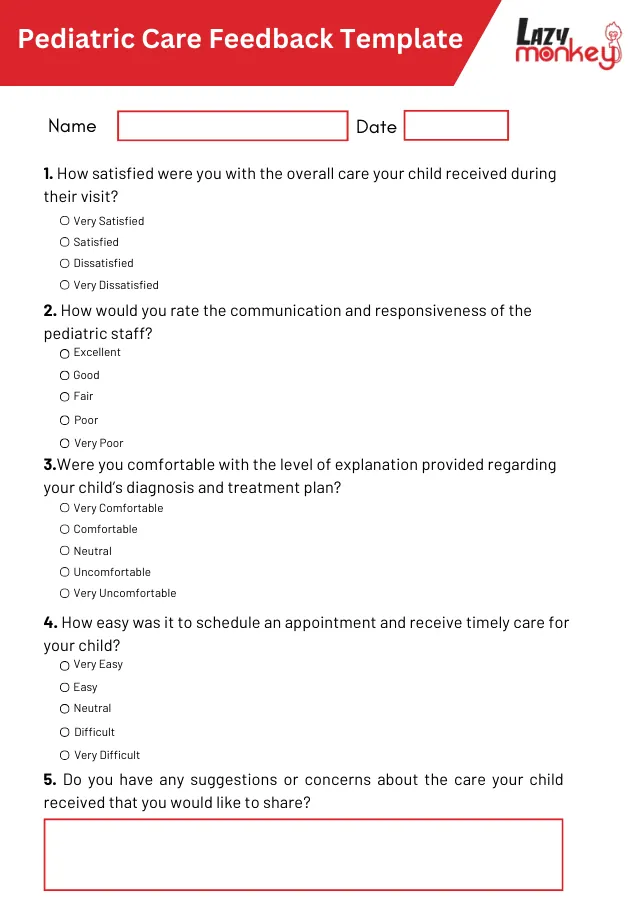
A one-page form for parents to fill in after an outpatient visit or before leaving the ward. Each question has answer options worded for that question, and the last one is a free-text box for suggestions or concerns. It starts with name and date.
- How satisfied were you with the overall care your child received during their visit? (Very satisfied / Satisfied / Dissatisfied / Very dissatisfied)
- How would you rate the communication and responsiveness of the pediatric staff? (Excellent / Good / Fair / Poor / Very poor)
- Were you comfortable with the level of explanation provided regarding your child's diagnosis and treatment plan? (Very comfortable / Comfortable / Neutral / Uncomfortable / Very uncomfortable)
- How easy was it to schedule an appointment and receive timely care for your child? (Very easy / Easy / Neutral / Difficult / Very difficult)
- Do you have any suggestions or concerns about the care your child received that you would like to share? (comment)
Example 2: Pediatric Feedback Form With a Smiley-Face Scale
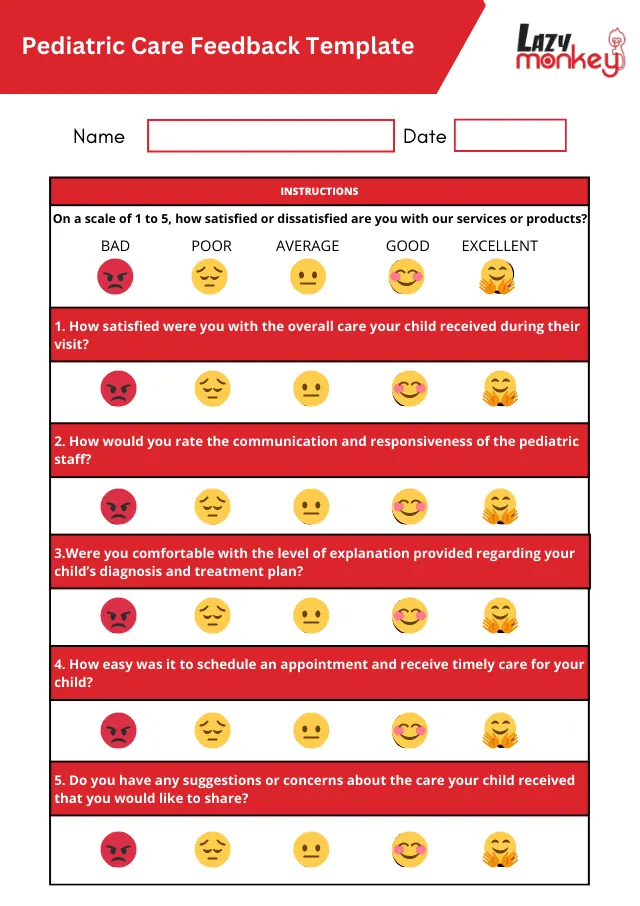
The same five questions, each answered on one five-point face scale (Bad / Poor / Average / Good / Excellent), under the instruction "On a scale of 1 to 5, how satisfied or dissatisfied are you with our services or products?" It is quicker on a tablet in a busy clinic, and older children can help choose the face. Note that in this version question 5, the suggestions question, also has only a face scale; add a comment box if you want written suggestions.
- Name and date
- Questions: overall care your child received; communication and responsiveness of the pediatric staff; explanation of your child's diagnosis and treatment plan; ease of scheduling and timely care; suggestions or concerns (Bad / Poor / Average / Good / Excellent)
Components of an Effective Pediatric Care Feedback Template
Beyond the usual ratings for care, communication and waiting, a pediatric form needs questions that only apply to children:
- Who is answering: parent, guardian or other relative, plus the child's age group and whether it was an OPD visit, a ward stay or an emergency. Results for a newborn and a teenager are not comparable.
- How staff treated the child: "Did staff explain things to your child in a way they could understand?" and "Did staff help your child feel less anxious or scared?"
- Pain and procedures: "Was your child's pain well managed?" and "Were you allowed to stay with your child during tests or procedures?"
- Involving parents: "Were you involved in decisions about your child's care?" and "Were your questions answered?"
- Child-friendly environment: waiting area, play space, cleanliness, and facilities such as a feeding or changing area.
- Going home: "Do you know what to do if your child's condition gets worse?" and whether medicine doses for the child's weight were explained.
- Overall rating and one comment box.
Keep it to one page and avoid medical terms. If you want feedback from children themselves, use a separate face-scale card with two or three simple questions rather than adding them to the parent form.
Implementing the Pediatric Care Feedback Template in Your Practice
- Timing: parents with a sick or tired child will not stay to fill in a form. A QR code at the pharmacy or billing counter, or a link sent the same evening, works better than a form at the door.
- Brief the team: reception and nursing staff should know the form exists and mention it when the visit ends.
- Get a balanced picture: ask every family, not just those staff choose, so results do not come only from the most pleased or most upset parents.
- Who acts on it: the pediatric nurse in charge reviews comments weekly; anything about a child's safety, pain or a staff member's behaviour goes to the head of department the same day and the family is contacted.
- Respond specifically: thank parents, say what will change, and tell them later what did. A notice in the waiting area listing changes made from parent feedback shows that forms are read.
- Look for patterns: group comments by theme (waiting, explanation, pain, environment) and compare month by month, rather than reacting to single forms.
Digital forms make most of this easier: parents answer on their own phone, reminders go out automatically, and the form can be offered in more than one language.
Frequently Asked Questions
How Can I Create An Effective Pediatric Care Feedback Template?
To create an effective Pediatric Care Feedback Template, focus on simplicity and clarity. Include multiple-choice questions for efficiency and open-ended questions for detailed responses. Ensure the template is easy to understand and can be filled out quickly.
What Are The Benefits of Using Digital Tools For Feedback Collection?
Digital tools offer convenience, automated reminders, real-time analysis, and accessibility. They make it easier for parents to provide feedback and for healthcare providers to collect and act on that feedback.
How Should I Respond to Feedback Collected Through The Template?
Respond to feedback promptly, specifically, and appreciatively. Follow up with parents to show them how their input led to improvements in care, which encourages continued participation in the feedback process.
Can Feedback Lead to Improvements in Pediatric Care?
Yes, feedback can lead to significant improvements in pediatric care. By regularly analyzing feedback and implementing changes, healthcare providers can enhance the quality of care, increase patient satisfaction, and improve overall outcomes.
Filed under Feedback Form Templates · First published