
Quick answer
What should a maternity ward feedback template include?
A maternity ward feedback template helps hospitals improve care for new mothers. It should include questions on:
- The admission process
- Labour and delivery experience
- Postnatal care for mother and baby
- Communication with the care team
- Ward cleanliness, comfort and facilities
- Overall satisfaction and suggestions

In this article (9 sections)
- Importance Of Feedback In Maternity Wards
- Key Components Of An Effective Feedback Template
- Examples of Maternity Feedback Form
- When to Collect Feedback from New Mothers
- Sample Maternity Feedback Questions by Stage
- Implementing the Feedback Process
- Common Mistakes in Maternity Ward Feedback
- Conclusion
- Frequently Asked Questions
A maternity ward feedback template asks new mothers, before they go home, how they were treated from admission through labour, delivery and the first days with their baby. This article gives three sample forms in full, questions grouped by stage of care, advice on when to ask and how to act on the answers. Because birth is such a personal experience, the questions cover dignity, privacy and support as well as clinical care.
Importance Of Feedback In Maternity Wards
The general case for patient feedback is covered in the hospital feedback form template. In Indian public hospitals, maternity feedback also has a formal role. The Ministry of Health and Family Welfare launched the LaQshya labour room initiative in December 2017 to improve care around childbirth and promote respectful maternity care. Labour rooms and maternity operation theatres certified under the National Quality Assurance Standards qualify for LaQshya incentives only if, among other conditions, at least 80% of their beneficiaries are satisfied or highly satisfied (NHSRC guidance note on LaQshya incentives).
Key Components Of An Effective Feedback Template
Build the form around the stages of care, so every low score points to a stage and a team:
- Admission Process Evaluation: how quickly and clearly the mother was admitted, and whether she felt informed and comfortable.
- Labour and Delivery Experience: support during labour and delivery, including pain management and how quickly staff responded.
- Postnatal Care Assessment: care for mother and baby after delivery, including breastfeeding support and postpartum instructions.
- Communication and Interaction: whether concerns were heard and information was explained clearly.
- Respect, Privacy and Safety: whether the mother felt secure, was treated with dignity and had her cultural and personal preferences respected.
- Facility and Environment Feedback: cleanliness, comfort and facilities for both mother and baby.
- Overall Satisfaction and Suggestions: an overall rating and space for comments on what would improve the ward.
Examples of Maternity Feedback Form
Example 1: Open-Ended Maternity Feedback Form
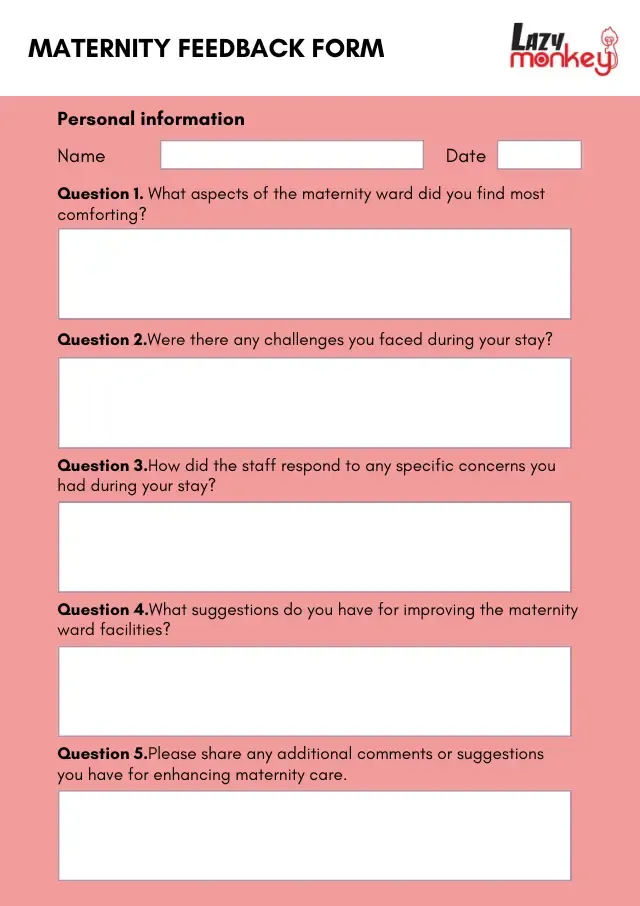
A comment-based form for mothers willing to write more, or for a volunteer to fill in while talking to the mother before discharge. After name and date, each question has a comment box.
- What aspects of the maternity ward did you find most comforting? (comment)
- Were there any challenges you faced during your stay? (comment)
- How did the staff respond to any specific concerns you had during your stay? (comment)
- What suggestions do you have for improving the maternity ward facilities? (comment)
- Please share any additional comments or suggestions you have for enhancing maternity care. (comment)
Example 2: Multiple-Choice Maternity Ward Feedback Form
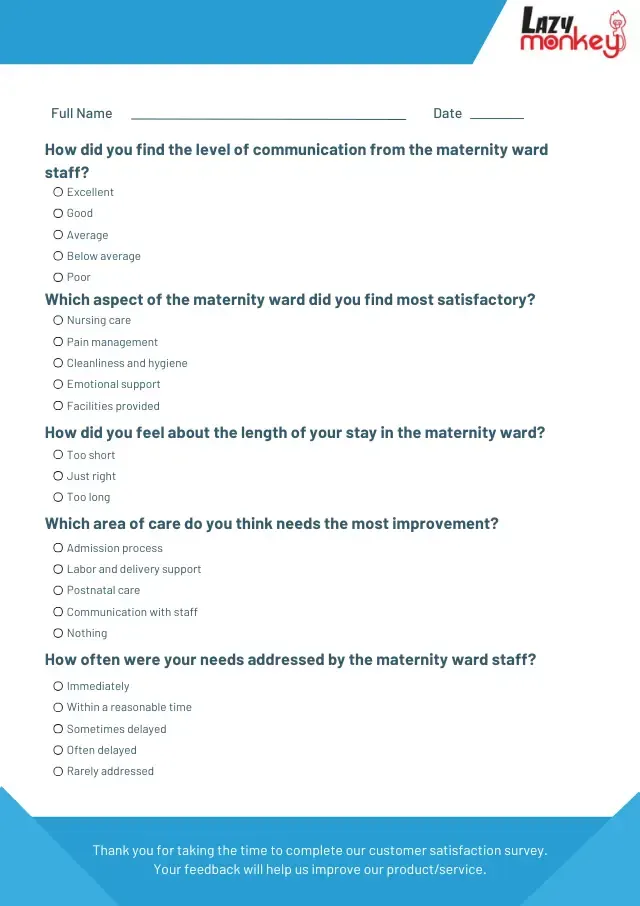
A tick-box form that is quick to complete and easy to count. Two questions ask the mother to pick the best and the weakest part of her care, showing the ward where to focus. It asks for full name and date.
- How did you find the level of communication from the maternity ward staff? (Excellent / Good / Average / Below average / Poor)
- Which aspect of the maternity ward did you find most satisfactory? (Nursing care / Pain management / Cleanliness and hygiene / Emotional support / Facilities provided)
- How did you feel about the length of your stay in the maternity ward? (Too short / Just right / Too long)
- Which area of care do you think needs the most improvement? (Admission process / Labor and delivery support / Postnatal care / Communication with staff / Nothing)
- How often were your needs addressed by the maternity ward staff? (Immediately / Within a reasonable time / Sometimes delayed / Often delayed / Rarely addressed)
Example 3: Yes/No Maternity Ward Survey Form
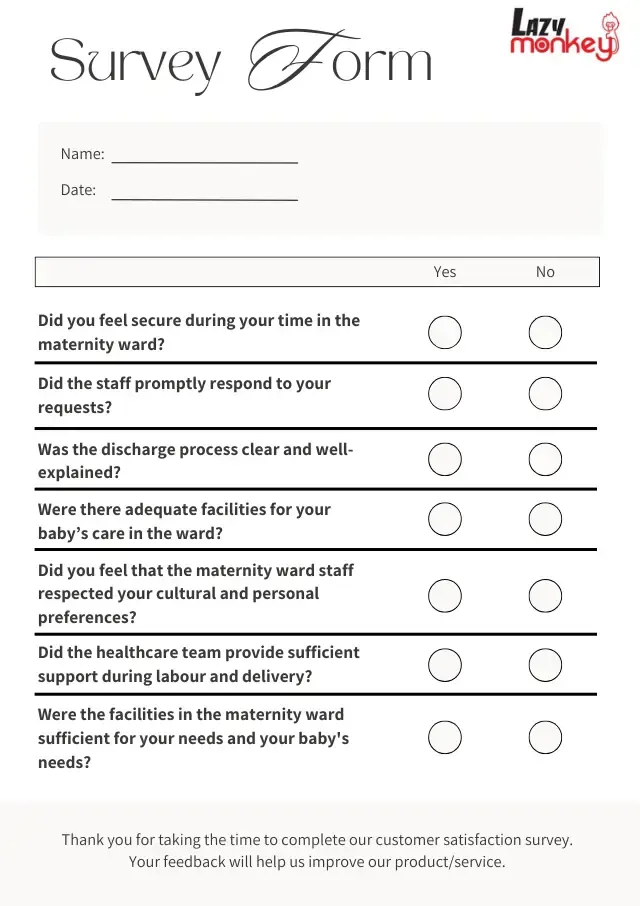
The shortest of the three: seven yes/no questions a tired mother can answer in a minute, covering safety, responsiveness, discharge, respect and support in labour. With no comment box, it shows that something went wrong but not what, so add one open question.
- Did you feel secure during your time in the maternity ward? (Yes / No)
- Did the staff promptly respond to your requests? (Yes / No)
- Was the discharge process clear and well-explained? (Yes / No)
- Were there adequate facilities for your baby’s care in the ward? (Yes / No)
- Did you feel that the maternity ward staff respected your cultural and personal preferences? (Yes / No)
- Did the healthcare team provide sufficient support during labour and delivery? (Yes / No)
- Were the facilities in the maternity ward sufficient for your needs and your baby’s needs? (Yes / No)
When to Collect Feedback from New Mothers
- At discharge, not during labour. Hand over a printed form, tablet or QR code once the discharge process is complete, when the mother can look back on the whole stay. Let a family member help.
- Away from the staff who cared for her. A volunteer, sealed box or QR code makes honesty easier.
- In her language. Print the form in the local language and offer to read it aloud for mothers who cannot read.
- A follow-up after going home. A short call or message a week or two later can ask about breastfeeding, postnatal instructions and any problems since discharge, which a form at the bedside cannot capture.
Sample Maternity Feedback Questions by Stage
Pick two or three questions per stage and add a rating scale or yes/no answer to each.
| Stage | Sample questions |
|---|---|
| Admission | Were you seen promptly when you arrived? Was the admission process explained clearly? |
| Labour and delivery | Were you kept informed about your progress? Was your pain managed the way you wanted? Were you allowed a companion of your choice? |
| Privacy and respect | Were screens or curtains used during examinations? Did staff speak to you respectfully at all times? |
| Postnatal care | How well did staff help you start breastfeeding? Were your own pain and recovery checked regularly? |
| Baby care | Were you shown how to feed your baby, keep them warm and care for the umbilical cord? |
| Discharge | Were you told which danger signs to watch for in yourself and your baby? Do you know when to return for check-ups and vaccinations? |
| Open-ended | What would have made your stay better? |
Implementing the Feedback Process
Who Should See the Results and How Fast
- The same day: any comment about disrespect, unsafe care or a possible danger sign in mother or baby goes straight to the ward in-charge and the quality team, and someone calls the mother back.
- Weekly: the labour room and postnatal ward in-charges review comments with their nursing teams.
- Monthly: the quality team reports the share of satisfied mothers, by stage of care, to hospital management and tracks it over time.
Analyzing And Acting On Feedback
Split results by shift and by type of delivery, since mothers who had a caesarean section often have different concerns. Use the “needs the most improvement” answers from Example 2 to pick one or two issues, give each an owner and a deadline, and check whether the next month’s results move.
Common Mistakes in Maternity Ward Feedback
- Asking about food and facilities but not about respect, privacy and support during labour.
- Handing out the form while the mother is exhausted or in pain, or while the staff who cared for her stand by.
- Using yes/no questions alone, with no space to explain a “No”.
- Leaving generic wording in the template, such as the “customer satisfaction survey” and “product/service” closing note in Examples 2 and 3.
- Collecting forms but never sharing results with staff or telling mothers what changed.
Conclusion
Choose the form that fits your ward, ask at discharge in the mother’s language, and route serious comments to the right person the same day.
Frequently Asked Questions
What Should Be Included In A Maternity Ward Feedback Template?
A maternity ward feedback template should include questions covering the admission process, labor and delivery experience, postnatal care, communication, and facilities.
How Can Feedback Improve Maternity Care?
Feedback helps identify areas that need improvement, ensuring that maternity wards can continuously enhance the quality of care provided to new mothers.
What Is The Best Way To Distribute A Maternity Ward Feedback Form?
Feedback forms can be distributed through various channels, including online surveys, printed forms, or in-person interviews, depending on the resources and patient preferences of the ward.
Why Is Patient-Centered Language Important In Feedback Forms?
Using patient-centered language makes new mothers feel valued and comfortable, leading to more honest and thoughtful responses.
How Often Should Feedback Be Collected In Maternity Wards?
Feedback should be collected regularly, ideally after each patient’s discharge, to ensure that the ward continuously adapts and improves based on real-time insights.
Filed under Feedback Form Templates · First published