Quick answer
What should a facility cleanliness feedback form include?
A facility cleanliness feedback form should rate each area separately, so every low score points to a specific place. Cover:
- Restrooms, including soap and towels
- Floors, desks and surfaces
- High-touch points like door handles
- Waste bins
- Air quality and ventilation
- Open questions on what needs attention

In this article (7 sections)
A facility cleanliness feedback template lets patients, visitors and staff rate how clean each part of a building is, so the housekeeping team knows exactly where to act. This article gives two sample forms in full, sample questions grouped by area and steps for acting on the results. It is written with hospitals in mind but works for any facility.
Importance of Facility Cleanliness
Dirty surfaces and washrooms spread infection, and cleanliness is one of the first things patients and visitors judge a facility on. Regular cleaning also protects furniture and equipment, and inspectors expect to see it documented. In India, public health facilities are assessed on cleanliness, hygiene and infection control under the Kayakalp guidelines. Feedback from the people using each area shows where the cleaning schedule is falling short between inspections. For why patient feedback matters more broadly, see the hospital feedback form template.
How to Create an Effective Facility Cleanliness Feedback Template
1. Understand the purpose
Decide whether the form checks general cleanliness, looks for specific problem areas or tracks an ongoing issue. The purpose decides which areas and questions to include.
2. Identify key areas for feedback
Your feedback form should cover all areas within the facility that require a cleanliness assessment. These areas can include:
- Restrooms
- Hallways and corridors
- Offices or workstations
- Public or shared spaces (lounges, break rooms)
- Entrances and exits
- Windows and floors
- High-touch areas (door handles, elevator buttons, etc.)
Create categories for each of these areas to make it easy for respondents to provide specific feedback.
3. Use clear and concise language
Use simple words and name areas the way visitors know them (“ground-floor washroom near OPD”, not a room code).
4. Incorporate rating scales
Incorporating rating scales (e.g., 1 to 5 or 1 to 10) allows respondents to provide a quick assessment of cleanliness levels. For example, you can ask respondents to rate the cleanliness of restrooms on a scale of 1 to 5, with 1 being “very dirty” and 5 being “very clean.”
5. Provide open-ended questions
While rating scales are helpful for quantitative data, open-ended questions allow respondents to provide qualitative feedback. These questions allow people to express concerns or suggest improvements in their own words. Examples of open-ended questions include:
- Which area needed more attention, and what did you notice?
- What would make this facility feel cleaner?
6. Offer multiple submission options
To encourage participation, make sure your feedback template can be submitted both online and offline. Providing options such as mobile-friendly forms, email submissions, or paper forms can help you reach a wider audience.
7. Follow-up feedback
Acknowledge the feedback and tell respondents what is being done about their concerns, for example on a notice near the area that was fixed.
Example 1: Multiple-Choice Facility Cleanliness Feedback Form
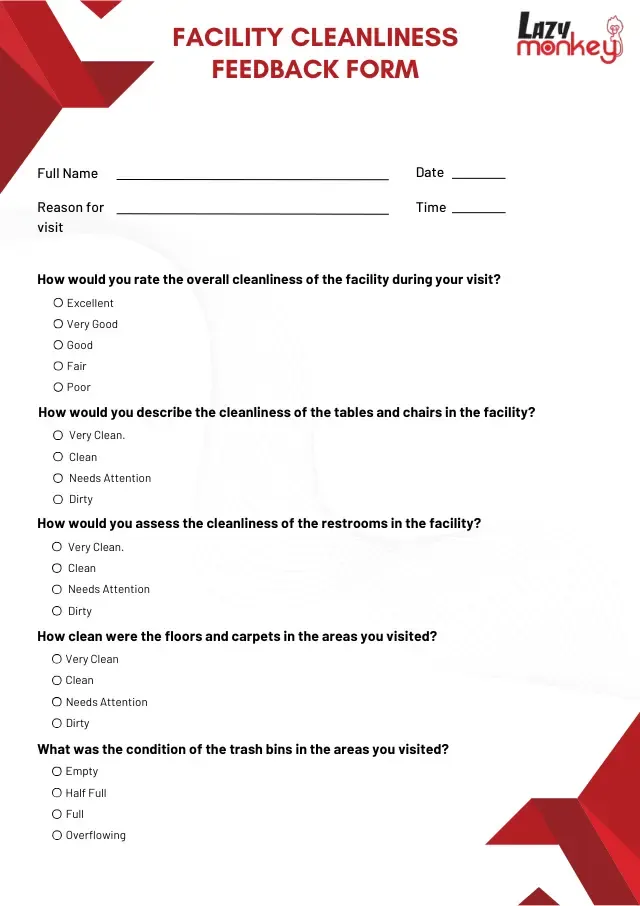
A quick tick-box form for visitors or patients to fill in at the end of a visit. It records the full name, reason for visit, date and time, then asks for a rating of each area, so a low score points straight to the place that needs attention.
- How would you rate the overall cleanliness of the facility during your visit? (Excellent / Very good / Good / Fair / Poor)
- How would you describe the cleanliness of the tables and chairs in the facility? (Very clean / Clean / Needs attention / Dirty)
- How would you assess the cleanliness of the restrooms in the facility? (Very clean / Clean / Needs attention / Dirty)
- How clean were the floors and carpets in the areas you visited? (Very clean / Clean / Needs attention / Dirty)
- What was the condition of the trash bins in the areas you visited? (Empty / Half full / Full / Overflowing)
Example 2: Open-Ended Facility Cleanliness Feedback Form
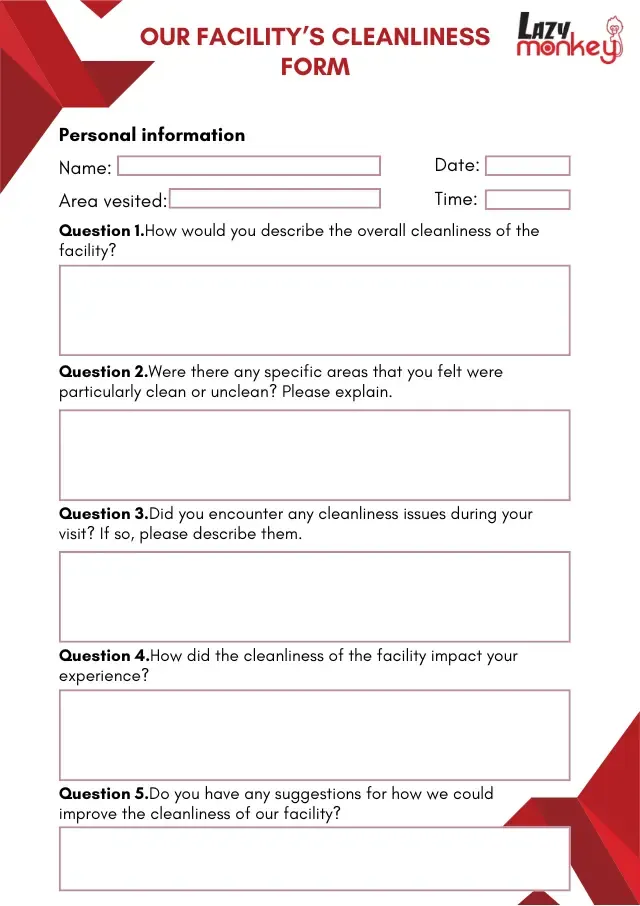
A comment-based form that asks people to describe what they saw rather than tick a rating. It takes longer to fill in and to analyse than Example 1, but it captures specific problems and suggestions. It suits a monthly or quarterly review, or a follow-up after Example 1 shows a low score. The personal information section asks for name, area visited, date and time.
- How would you describe the overall cleanliness of the facility? (comment)
- Were there any specific areas that you felt were particularly clean or unclean? Please explain. (comment)
- Did you encounter any cleanliness issues during your visit? If so, please describe them. (comment)
- How did the cleanliness of the facility impact your experience? (comment)
- Do you have any suggestions for how we could improve the cleanliness of our facility? (comment)
Best Practices for Maintaining Hygiene Standards
To maintain high hygiene standards in your facility, consider implementing the following best practices:
1. Develop a cleaning schedule
A consistent cleaning schedule ensures that all areas of the facility are cleaned and sanitized regularly. Depending on the facility type, high-traffic areas may require more frequent cleaning.
2. Use proper cleaning supplies
Ensure that cleaning staff are equipped with the appropriate supplies, including disinfectants, cleaning agents, and equipment. For healthcare facilities, it’s important to use hospital-grade disinfectants that effectively kill harmful pathogens.
3. Train cleaning staff
Proper training is essential for maintaining hygiene standards. Train your cleaning staff on best practices for cleaning, disinfecting, and handling cleaning chemicals. Additionally, staff should be trained in hygiene protocols, including handwashing and personal protective equipment (PPE) usage.
4. Focus on high-touch areas
High-touch areas, such as door handles, light switches, and elevator buttons, are hotspots for germs. Make sure these areas are cleaned and disinfected frequently to minimize the spread of bacteria and viruses.
5. Encourage hand hygiene
Hand hygiene is one of the most effective ways to prevent the spread of germs (see infection control best practices for hospitals). Ensure that hand sanitizers and handwashing stations are easily accessible throughout the facility. Display signage to remind staff and visitors to wash their hands regularly.
6. Monitor and review cleanliness regularly
Regularly inspect the facility to monitor cleanliness levels and identify areas that need improvement. Reviewing cleanliness standards and conducting periodic audits can help ensure that hygiene protocols are being followed effectively.
Sample Cleanliness and Housekeeping Feedback Questions
Group questions by area so that every low score points to a specific place. Each question can use a 1 to 5 scale or a simple Excellent / Good / Needs Improvement rating. Ask both staff and visitors to get more than one point of view.
| Area | Sample questions |
|---|---|
| Restrooms | How clean were the toilets? Were soap and towels available? Did you notice any unpleasant odor? |
| Floors, desks and surfaces | How clean were the floors and furniture in this area? Did door handles and other high-touch points look clean? |
| Waste bins | Were the waste bins emptied, or were any overflowing? |
| Air and ventilation | Did the area feel fresh and well ventilated? |
| Open-ended | Which area needed more attention, and what did you notice? What would make this facility feel cleaner? |
Add questions for the areas specific to your facility. In a hospital, that means patient wards and operating rooms; in a bank, ATMs and customer counters.
How to Act on Cleanliness Survey Results
- Find the root cause of low scores. If one area, such as a restroom, keeps scoring low, check whether it is cleaned too rarely or runs short of supplies.
- Fix high-traffic areas first. Public-facing spaces affect how users see the facility the most, so start there.
- Set measures for the cleaning team, such as average cleaning time, how often issues are reported and the overall cleanliness rating, and track them over time.
- Train staff and upgrade equipment or supplies where the feedback shows gaps.
- Share the results with staff, management and users. Simple charts make trends easy to follow.
- Run follow-up surveys and compare the results with earlier rounds to check whether the changes worked.
- Keep the records. Past survey results document that cleanliness is checked regularly, which helps during inspections.
Conclusion
Use the tick-box form for frequent, area-by-area checks and the open-ended form when you need detail. Combined with a cleaning schedule, trained staff and regular inspections, the feedback shows whether hygiene standards are holding up where people actually notice them.
Frequently Asked Questions
Why Is Facility Cleanliness Feedback Important For Hospitals?
Cleanliness plays a crucial role in patient safety and satisfaction. Feedback helps healthcare facilities identify areas where hygiene standards may need improvement and ensures that cleanliness is maintained at the highest levels.
How Can I Provide Feedback On The Cleanliness Of The Hospital Facility?
Most hospitals offer multiple ways to provide feedback, including surveys, online portals, suggestion boxes, or directly speaking with hospital staff. Your input is valuable in maintaining a clean and safe environment.
What Steps Does The Hospital Take After Receiving Cleanliness-Related Feedback?
Once feedback is received, the hospital reviews the comments, identifies specific areas of concern, and implements corrective actions. This may involve additional cleaning protocols, staff training, or addressing any other reported hygiene issues.
Can I Provide Cleanliness Feedback Anonymously?
Yes, most healthcare facilities allow for anonymous feedback to ensure patients feel comfortable sharing their honest experiences without fear of repercussions. Anonymous feedback is still taken seriously and used to improve hygiene standards.
What Questions Should A Cleanliness Feedback Form Include?
Include a rating for each area, such as restrooms, floors and surfaces, high-touch points, waste bins and air quality, plus one or two open-ended questions asking what needed more attention.
How Often Should A Facility Cleanliness Survey Be Conducted?
A quarterly survey is a sensible baseline, while high-traffic environments such as hospitals may need monthly checks. Compare each round with the last to see whether changes are working.
Filed under Feedback Form Templates · First published