Quick answer
What is a nurse performance feedback template?
A nurse performance feedback template is a structured tool supervisors use to evaluate a nurse's performance and give constructive feedback. It standardises reviews across communication skills, patient care quality, teamwork, professionalism, problem-solving and ongoing education, so feedback stays consistent and objective and helps nurses improve their interactions with patients.

In this article (9 sections)
- Why Nurse Performance Feedback Matters?
- Top Nurse Performance Feedback Template Examples
- Key Components of a Nurse Performance Feedback Template
- How to Implement a Nurse Performance Feedback Template?
- Enhancing Patient Interaction through Feedback
- Challenges in Giving Nurse Performance Feedback
- Creating a Supportive Environment for Feedback
- Conclusion
- Frequently Asked Questions
This article gives two sample nurse performance feedback forms in full, explains what each section should assess and shows how to run review sessions that nurses find useful rather than threatening. The forms are filled in by a nurse manager, senior nurse or peer about one nurse: they are staff reviews, not patient surveys.
Why Nurse Performance Feedback Matters?
Nurses spend more time with patients than any other clinician, so gaps in communication or routine show up quickly in the patient experience. Regular, structured feedback catches those gaps early and recognises good practice. Patients’ own views of nursing care are best collected through a patient survey such as the hospital feedback form template; read the two side by side.
Top Nurse Performance Feedback Template Examples
Example 1: Open-Ended Nurse Performance Review Form
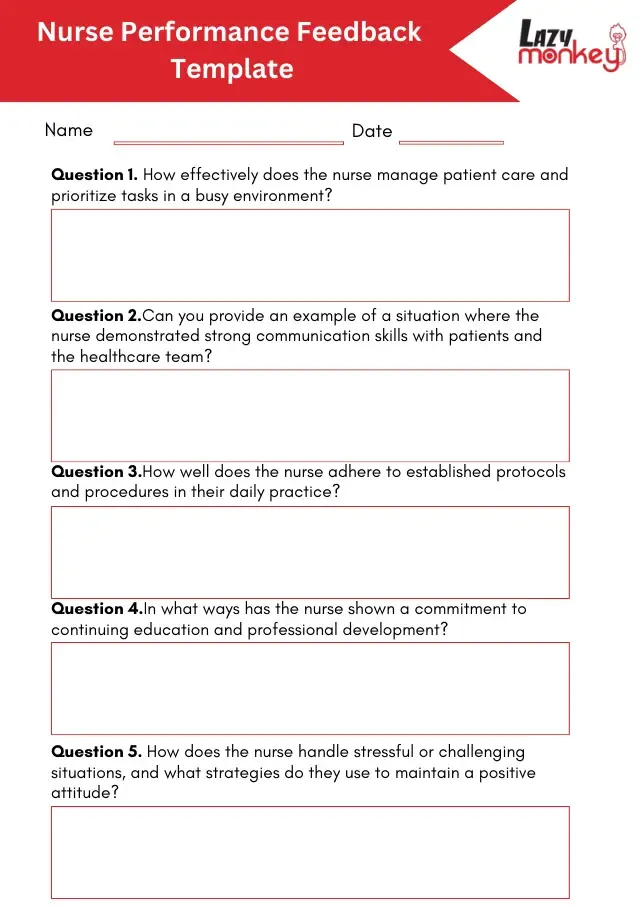
A written review form for a nurse manager or senior colleague to complete about one nurse, usually before a review meeting. It has name and date fields, and every question has a comment box, so the reviewer has to give specific examples rather than a score.
- How effectively does the nurse manage patient care and prioritize tasks in a busy environment? (comment)
- Can you provide an example of a situation where the nurse demonstrated strong communication skills with patients and the healthcare team? (comment)
- How well does the nurse adhere to established protocols and procedures in their daily practice? (comment)
- In what ways has the nurse shown a commitment to continuing education and professional development? (comment)
- How does the nurse handle stressful or challenging situations, and what strategies do they use to maintain a positive attitude? (comment)
Example 2: Nurse Performance Rating Form with a 1 to 5 Face Scale
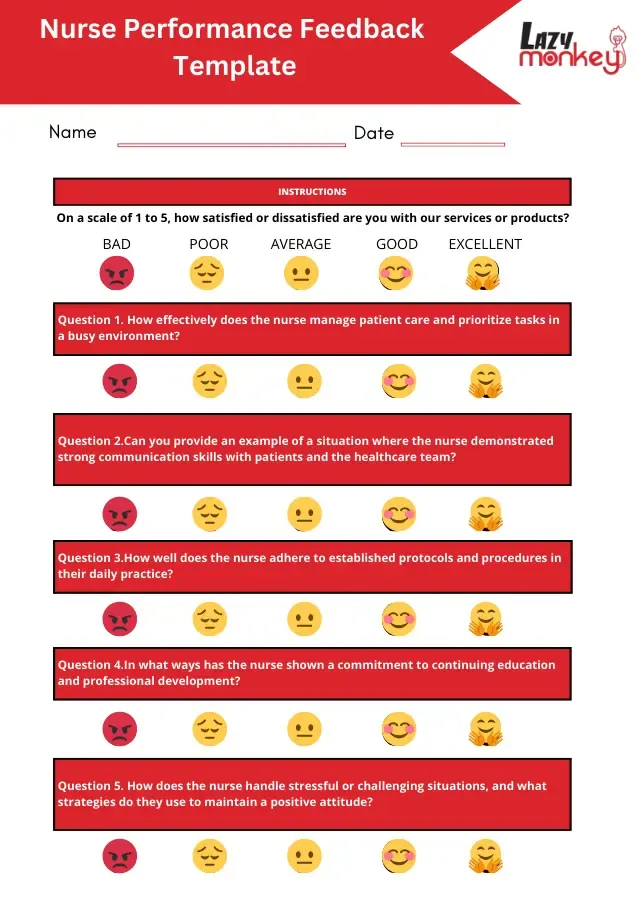
The same five questions as Example 1, each rated on a 1 to 5 face scale instead of a comment box. It is quicker to fill in and easier to compare across review cycles, but it loses the examples that make Example 1 useful in a meeting, so many managers record the ratings and add one or two written examples. Before using it, reword the generic instruction line to “rate the nurse on each point”, and rephrase questions 2 and 4 so they can be rated (for example, “How strong are the nurse’s communication skills with patients and the team?”).
- Name and date
- Instructions: On a scale of 1 to 5, how satisfied or dissatisfied are you with our services or products? (Bad / Poor / Average / Good / Excellent)
- Question 1: How effectively does the nurse manage patient care and prioritize tasks in a busy environment? (1 to 5)
- Question 2: Can you provide an example of a situation where the nurse demonstrated strong communication skills with patients and the healthcare team? (1 to 5)
- Question 3: How well does the nurse adhere to established protocols and procedures in their daily practice? (1 to 5)
- Question 4: In what ways has the nurse shown a commitment to continuing education and professional development? (1 to 5)
- Question 5: How does the nurse handle stressful or challenging situations, and what strategies do they use to maintain a positive attitude? (1 to 5)
Key Components of a Nurse Performance Feedback Template
Each component below can be one section of the form, with a rating and a comment box:
- Communication Skills: Evaluate how effectively the nurse communicates with patients, families, and other healthcare team members. This includes active listening, clear explanations, and empathy.
- Patient Care Quality: Assess the nurse’s ability to deliver high-quality care. This involves clinical skills, adherence to care protocols, and the ability to adapt to patient needs.
- Teamwork and Collaboration: Consider how well the nurse works with colleagues. Collaboration is crucial in healthcare, where a team-based approach often determines patient outcomes.
- Professionalism: Review the nurse’s professionalism, including punctuality, appearance, attitude, and adherence to ethical standards.
- Problem-Solving Abilities: Determine the nurse’s capability in identifying issues, making decisions, and solving problems, particularly in high-pressure situations.
- Ongoing Education and Development: Encourage continuous learning by evaluating the nurse’s commitment to professional development through courses, certifications, or on-the-job training.
How to Implement a Nurse Performance Feedback Template?
1. Customize Template to Fit Your Needs
Adapt the standard sections to your setting. A hospital in a high-trauma area might weight quick decision-making and crisis management more heavily than a long-term care facility would.
2. Train Supervisors on Delivering Feedback
Giving feedback is a skill in itself. Train supervisors to use the template, give constructive criticism, offer praise where it is due and keep a supportive tone, so the session encourages growth rather than defensiveness.
3. Schedule Regular Feedback Sessions
Regular sessions ensure issues are addressed promptly and improvements are recognised as they happen. They can be quarterly, bi-annually, or annually, depending on the facility’s protocols and the needs of the nursing staff.
4. Encourage Two-Way Communication
Ask nurses about the challenges they face, where they need more support and how patient care could improve. This dialogue builds ownership and accountability.
5. Follow-Up on Feedback Given
Agree goals and timelines at the end of each session, then review progress at the next one and adjust the goals as needed. Follow-up shows the nurse that their development is a priority.
Enhancing Patient Interaction through Feedback
Nurses are often the face of healthcare, so the review should look closely at how they interact with patients:
1. Emphasizing Empathy in Patient Care
Assess how well the nurse listens to patients, acknowledges their concerns and provides reassurance.
2. Communication as a Tool for Better Care
Look at communication with patients, families and other providers. Patients who understand their treatment plan are less anxious and more likely to follow medical advice.
3. Adapting to Diverse Patient Needs
Evaluate how well the nurse adapts care to cultural differences, language barriers and varying levels of health literacy.
4. Building Trust Through Professionalism
Review how the nurse conducts themselves, respects patient privacy and follows ethical standards, since these shape how much patients trust their care.
Challenges in Giving Nurse Performance Feedback
1. Balancing Criticism and Praise
Too much criticism demoralises, while too much praise hides areas needing improvement. Design the template so every review records both strengths and areas for growth.
2. Overcoming Resistance to Feedback
Some nurses resist feedback that feels overly critical or ignores their efforts. Frame it around support and development rather than judgement, and train supervisors to deliver it well.
3. Ensuring Objectivity in Evaluations
In a close-knit team, personal relationships can colour feedback. Specific, measurable criteria keep evaluations based on performance rather than personal bias.
4. Keeping Feedback Timely and Relevant
Feedback loses its impact if it waits for the annual review. Address issues as they arise and use the scheduled sessions to track progress.
Creating a Supportive Environment for Feedback
- Build a culture of feedback. Leadership sets the tone by asking for feedback on its own work and acting on it.
- Provide resources for improvement. Training, mentoring or new tools turn feedback into real change.
- Recognise improvement. Verbal acknowledgement in a session or formal awards motivate the nurse and encourage others.
Conclusion
Choose the open-ended form for in-depth reviews and the rating form for quick, comparable records, review nurses regularly, and agree goals at every session. Combined with patient feedback on nursing care, this gives a fair picture of each nurse’s strengths and development needs.
Frequently Asked Questions
What is A Nurse Performance Feedback Template?
A Nurse Performance Feedback Template is a structured tool used to evaluate and provide feedback on a nurse’s performance, focusing on areas such as communication, patient care, and teamwork.
How Can A Nurse Performance Feedback Template Improve Patient Care?
By providing structured feedback, nurses can identify areas for improvement, enhance their skills, and improve patient interactions, leading to better patient outcomes.
What Should Be Included in A Nurse Performance Feedback Template?
Key components include communication skills, patient care quality, teamwork, professionalism, problem-solving abilities, and commitment to ongoing education.
How Often Should Feedback Be Given Using The Template?
Feedback should be given regularly, such as quarterly, bi-annually, or annually, depending on the facility’s protocols and the needs of the nursing staff.
Filed under Feedback Form Templates · First published