
Quick answer
What should a billing and payment feedback form include?
A billing and payment feedback form should be short and focused on the transaction itself. Include:
- Clear, easy-to-follow instructions
- Questions directly about the transaction
- Rating scales to quantify feedback
- Open-ended questions for detail
- Optional contact details for follow-up

In this article (6 sections)
A billing and payment feedback template asks patients and their families how the billing side of a hospital or clinic visit went: whether the bill was clear, how long payment took, how the billing desk treated them and how insurance was handled. Billing is often the last thing a family deals with before going home, so a confusing bill or a long queue at the counter can colour how they remember the whole visit. This article gives four ready forms, the questions worth asking, and how to act on the answers. For general patient feedback across all departments, see our hospital feedback form template.
Examples of Billing and Payment Feedback Form Templates
Example 1: Three-Question Billing Feedback Survey
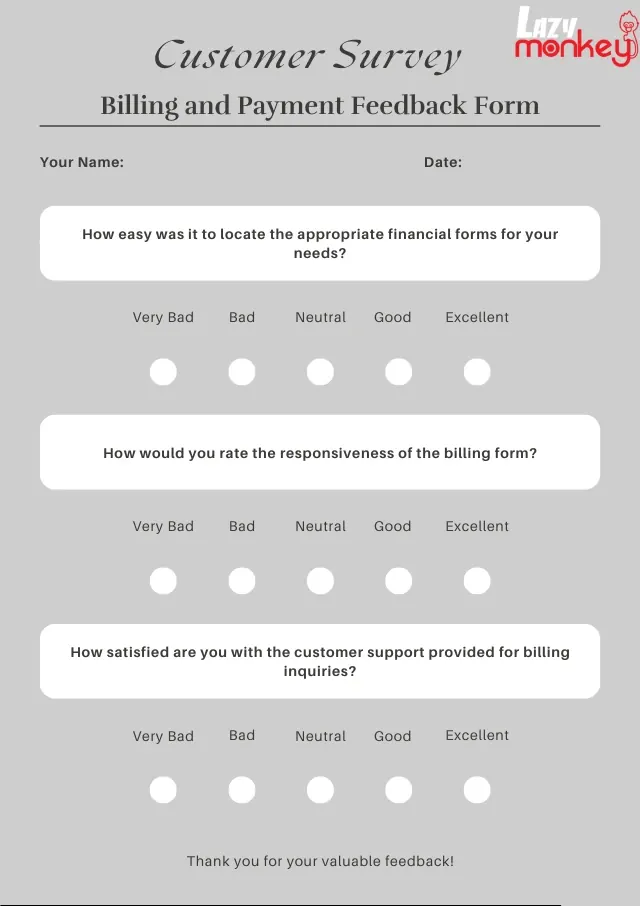
A short "Customer Survey" for patients or relatives to fill in at or just after the billing counter. All three questions are rated on the same five-point scale, so it takes seconds. It asks for name and date and ends with a thank-you line.
- How easy was it to locate the appropriate financial forms for your needs? (Very bad / Bad / Neutral / Good / Excellent)
- How would you rate the responsiveness of the billing form? (Very bad / Bad / Neutral / Good / Excellent)
- How satisfied are you with the customer support provided for billing inquiries? (Very bad / Bad / Neutral / Good / Excellent)
Example 2: Billing Feedback Form With Contact Details and Ratings
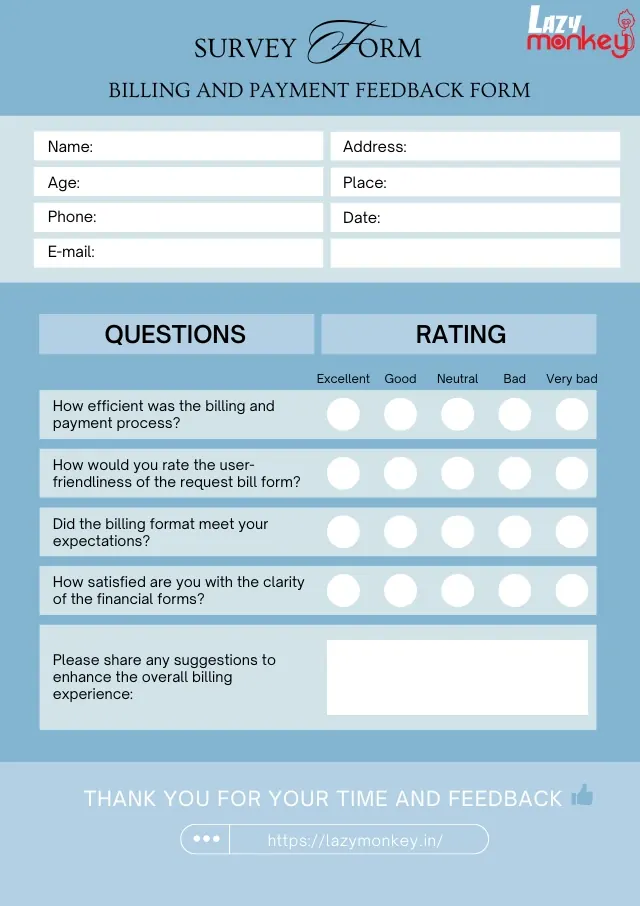
A fuller "Survey Form" that collects contact details, so the billing team can follow up on a complaint. Four questions are rated in a grid and the last is a comment box. Use it where you expect disputes to need a call back, and make the contact fields optional.
- Details: Name, Address, Age, Place, Phone, Date, E-mail
- How efficient was the billing and payment process? (Excellent / Good / Neutral / Bad / Very bad)
- How would you rate the user-friendliness of the request bill form? (Excellent / Good / Neutral / Bad / Very bad)
- Did the billing format meet your expectations? (Excellent / Good / Neutral / Bad / Very bad)
- How satisfied are you with the clarity of the financial forms? (Excellent / Good / Neutral / Bad / Very bad)
- Please share any suggestions to enhance the overall billing experience. (comment)
Example 3: Open-Answer Billing Feedback Form
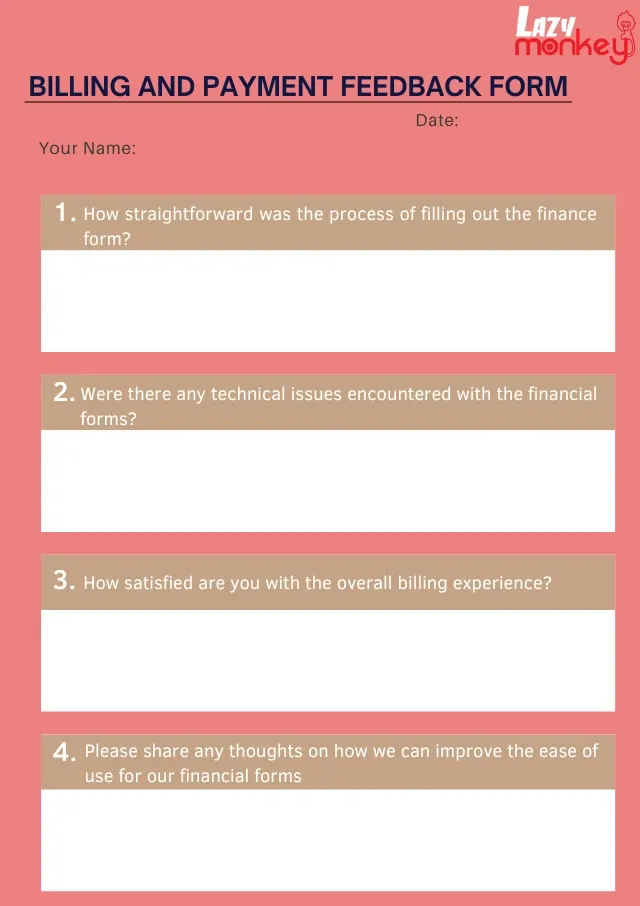
Four questions, each with a box for a written answer instead of a rating. This gives detail on what went wrong with forms or payment, but answers are harder to count, so it suits a small clinic or a short pilot rather than a busy hospital. It asks for name and date.
- How straightforward was the process of filling out the finance form? (comment)
- Were there any technical issues encountered with the financial forms? (comment)
- How satisfied are you with the overall billing experience? (comment)
- Please share any thoughts on how we can improve the ease of use for our financial forms. (comment)
Example 4: Open-Answer Billing Feedback Form, Alternative Layout
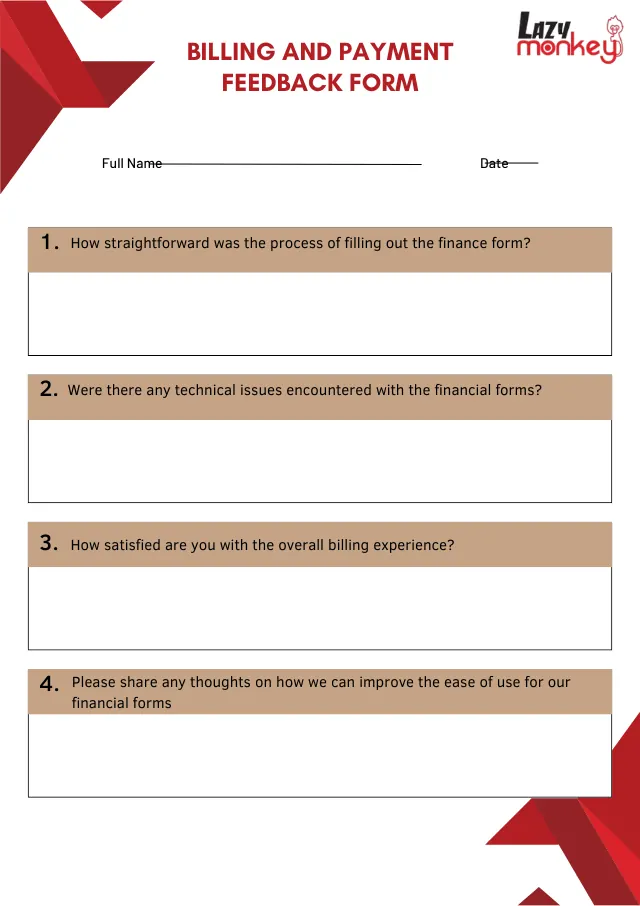
The same four open questions as Example 3, word for word, in a different design with "Full Name" and date at the top. Choose whichever layout fits your print style.
Creating an Effective Billing and Payment Feedback Template
The examples above are generic. For a hospital or clinic, adapt them so each question points to a part of the billing process you can change. Pick five to eight questions from these themes:
| Theme | Sample question | Answer format |
|---|---|---|
| Estimate | Were you given a cost estimate before treatment? | Yes / No |
| Estimate | How close was the final bill to the estimate you were given? | Much higher / Slightly higher / About the same / Lower |
| Bill clarity | How easy was your bill to understand? | 1 to 5 |
| Bill clarity | Were the charges on your bill explained when you asked? | Yes / Partly / No / Did not ask |
| Waiting | How long did you wait at the billing counter? | Under 10 minutes / 10 to 30 minutes / Over 30 minutes |
| Payment | Could you pay the way you wanted (cash, card, UPI, online)? | Yes / No |
| Insurance | If you used health insurance, how smooth was the insurance or TPA process? | 1 to 5 / Not applicable |
| Deposits and refunds | Was any deposit or refund handled correctly and on time? | Yes / No / Not applicable |
| Staff | How courteous and helpful were the billing staff? | 1 to 5 |
| Overall | How satisfied are you with the overall billing experience? | 1 to 5 |
| Open | What one thing would make paying your bill easier? | Comment |
A few design points specific to billing:
- Use the patient's words, not accounts terms: "your bill" and "the payment counter", not "request bill form" or "financial forms" as in the generic examples.
- Separate the bill from the care: a patient unhappy with the cost may rate everything low. Keep billing questions in their own short form or section so they do not mix with ratings of doctors and nurses.
- Make contact details optional, with a "please contact me about my bill" tick box: billing complaints often need a call back, but compulsory contact fields reduce honest answers.
- Offer it in the languages your patients read, on paper and by QR code.
When To Collect Billing and Payment Feedback
- Outpatients: a QR code at the billing or pharmacy counter, or a link on the printed receipt.
- Inpatients: after final billing at discharge. Do not ask while the family is still waiting for the bill to be prepared. For the rest of the discharge experience, use a discharge process feedback template.
- Insurance cases: where a claim is settled after the patient leaves, send a short follow-up once settlement is complete.
Implementing the Feedback
- Who sees it: the billing supervisor reviews comments daily; the finance head and patient-relations or quality team review monthly trends.
- How fast to act: a comment about a wrong charge, a missing refund or rude behaviour is a complaint. Contact the patient within a day or two, check the bill and explain or correct it. See our guide to handling patient complaints in hospitals.
- Analyse by theme: summarise ratings by question and month, and sort comments into themes such as unclear charges, estimate gap, waiting, insurance and staff behaviour.
- Fix the process, not just the case: if "unclear charges" keeps coming up, redesign the bill layout or give a short explanation sheet; if waiting is the issue, look at counter staffing at discharge peaks.
- Track the effect: compare the same questions before and after a change to see whether it worked.
Common Mistakes With Billing Feedback Forms
- Asking about "financial forms" when patients think in terms of bills, receipts and insurance.
- Using only open questions at a busy hospital, which leaves hundreds of comments and no score to track.
- Handing the form out before the bill is settled, when the family is stressed and short of time.
- Collecting feedback but never calling back the patients who reported a billing error.
Frequently Asked Questions
What Should A Billing Feedback Form Ask?
Ask about how clear the bill was, how it compared with the estimate, insurance or TPA processing, waiting time at the billing counter, staff courtesy and how refunds or disputes were handled, with one open question for comments.
Why Is Feedback Post-Transaction Important?
Feedback post-transaction helps businesses understand customers’ experiences and identify areas for improvement. This can lead to enhanced services and increased customer satisfaction.
How Can A Billing And Payment Feedback Template Improve Financial Transactions?
A billing and payment feedback template allows businesses to gather insights from customers about their transaction experiences. This feedback can be used to refine processes and improve overall efficiency.
What Should Be Included In A Feedback Template?
A feedback template should include clear instructions, relevant questions, rating scales, open-ended questions, and an option for respondents to provide contact information if needed.
How Can Businesses Analyze Feedback Effectively?
Businesses can analyze feedback by summarizing quantitative data from rating scales and examining qualitative data from open-ended questions for common themes and insights. This helps identify specific areas for improvement.
Filed under Feedback Form Templates · First published