Quick answer
What is a physical therapy feedback template?
A physical therapy feedback template is a form that collects patients' views on their therapy experience and progress. Therapists use it to track improvements, address concerns and tailor treatment plans to each patient. A good template mixes rating scales with open-ended questions, uses plain language and lets patients respond anonymously.

In this article (8 sections)
- Top Physical Therapy Feedback Template Examples
- When to Collect Physical Therapy Feedback
- Sample Physical Therapy Feedback Questions by Theme
- Creating an Effective Physical Therapy Feedback Template
- Who Should See the Feedback and How Fast to Act
- Common Mistakes in Physical Therapy Feedback
- Conclusion
- Frequently Asked Questions
A physical therapy feedback template asks patients, session by session, how their pain, movement and daily activities are changing, alongside how they find the therapy itself. This article gives two sample progress forms in full, explains when to ask, groups sample questions by theme and shows which answers need action the same day.
Top Physical Therapy Feedback Template Examples
Both examples are progress forms rather than satisfaction surveys: they track how the patient is doing between sessions, so the therapist can adjust the plan.
Example 1: Open-Ended Physical Therapy Progress Feedback Form
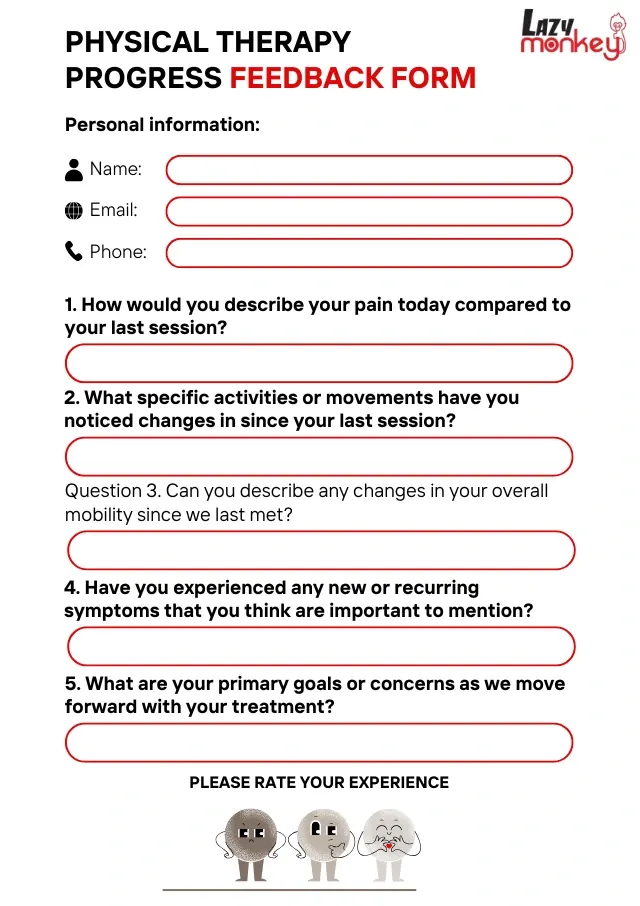
A written form for the patient to fill in before a session or at a progress review. Each question has a free-text answer, which gives the therapist detail in the patient’s own words. The personal information section asks for name, email and phone, so the form is not anonymous.
- How would you describe your pain today compared to your last session? (comment)
- What specific activities or movements have you noticed changes in since your last session? (comment)
- Can you describe any changes in your overall mobility since we last met? (comment)
- Have you experienced any new or recurring symptoms that you think are important to mention? (comment)
- What are your primary goals or concerns as we move forward with your treatment? (comment)
- Please rate your experience (three unlabelled cartoon faces)
Example 2: Physical Therapy Progress Form with Pain Scale and Ratings
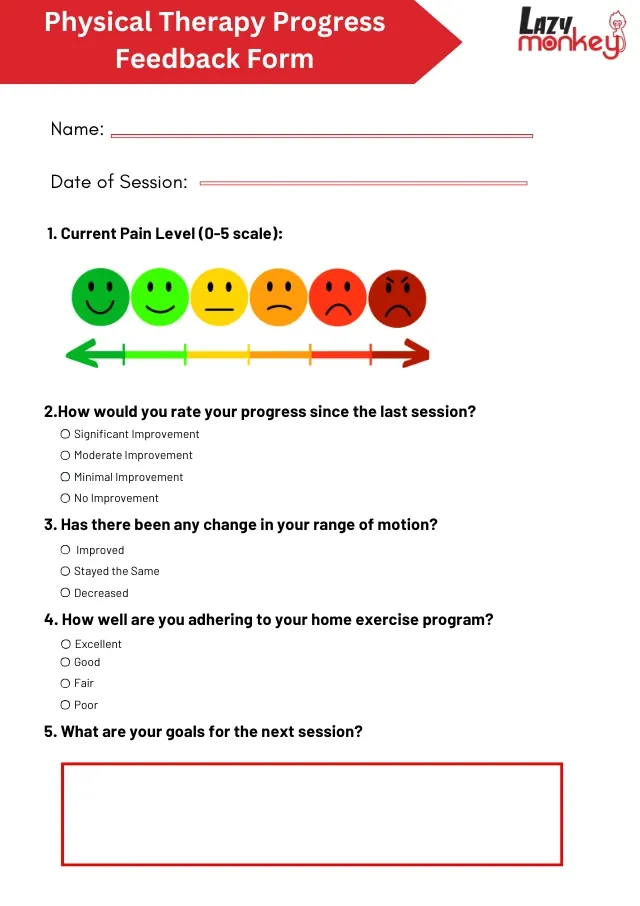
A quicker check-in for the start of every session. It asks for name and date of session, then uses a pain scale and tick boxes, so scores can be compared from one session to the next. Example 1 gives more detail; Example 2 is better for tracking trends.
- Current pain level (0 to 5 face scale, from green smiling to red frowning)
- How would you rate your progress since the last session? (Significant improvement / Moderate improvement / Minimal improvement / No improvement)
- Has there been any change in your range of motion? (Improved / Stayed the same / Decreased)
- How well are you adhering to your home exercise program? (Excellent / Good / Fair / Poor)
- What are your goals for the next session? (comment)
When to Collect Physical Therapy Feedback
- Before each session: the quick check-in (Example 2), filled in while the patient waits, so the therapist can adjust that day’s plan.
- At progress reviews: the detailed form (Example 1) every few sessions, alongside a review of the patient’s goals.
- At the end of a course of therapy: a short, anonymous satisfaction survey on scheduling, communication and the facility, such as the patient satisfaction survey template.
- After missed sessions: a brief call to ask why. Patients who stop coming often have a reason, such as pain, cost or travel, that the clinic can address.
Sample Physical Therapy Feedback Questions by Theme
| Theme | Sample questions |
|---|---|
| Pain and symptoms | How is your pain today compared with your last session? Have you noticed any new swelling, numbness or weakness? |
| Daily activities | Which everyday tasks are easier or harder than last week? Can you walk, climb stairs or lift as much as you need to? |
| Home exercises | On how many days did you do your exercises this week? Was any exercise unclear or painful? |
| Therapist and communication | Did your therapist explain the purpose of each exercise? Did you feel listened to? |
| Scheduling and facility | Did your sessions start on time? Was the equipment you needed clean and available? |
| Goals | What would you like to be able to do by the end of treatment? |
Creating an Effective Physical Therapy Feedback Template
The general steps for designing a patient form are covered in the hospital feedback form template. For physical therapy, these points matter most:
1. Identify key objectives
Decide whether the form tracks progress, satisfaction or both. Progress questions guide treatment; satisfaction questions guide how the clinic is run. Keep them on separate forms where you can.
2. Balance quantitative and qualitative data
Ratings show trends at a glance, while comments explain them. Use the same rating scale every session; if you switch from a 0 to 5 pain scale to a 0 to 10 one, scores can no longer be compared.
3. Keep it simple and accessible
Use plain words such as “stiffness” rather than clinical terms, and keep the pre-session form to five or six questions so it is done before the patient is called in.
4. Ensure anonymity and confidentiality
A progress form needs the patient’s name, because the therapist acts on it. Collect satisfaction feedback on a separate anonymous form, so patients can be honest about the therapist they will see again, and tell them how their information will be used.
5. Test and refine the template
Try the form with a small group of patients first, and fix questions that confuse them before using it with everyone.
Who Should See the Feedback and How Fast to Act
- The treating therapist, before the session starts: pain and progress answers. New or worsening symptoms, a fall, or new numbness or weakness should be reviewed before exercise begins, with a referral to the treating doctor where needed.
- The therapist, every week: the trend in scores. If a patient reports no improvement over several sessions, review the plan with them.
- The clinic manager, every month: satisfaction scores, scheduling complaints and reasons for missed sessions.
Common Mistakes in Physical Therapy Feedback
- Asking patients to rate their therapist on a named form handed back to that therapist, which produces polite rather than honest answers.
- Using unlabelled rating pictures, like the three faces at the end of Example 1. Label each face so answers mean the same to every patient.
- Collecting forms but not reading them before the session, so the patient repeats everything aloud.
- Not telling patients how their answers changed the plan, which makes them less likely to fill in the next form.
Conclusion
Use a quick, scored check-in before each session, a detailed form at progress reviews and an anonymous survey at the end of treatment. Read the answers before the patient walks in, and act on any warning signs the same day.
Frequently Asked Questions
What Is The Purpose Of A Physical Therapy Feedback Template?
A physical therapy feedback template is designed to collect patient insights on their therapy experience. It helps therapists monitor patient progress, adjust treatment plans, and improve the overall quality of care.
Can I Customize The Feedback Template For Different Types Of Therapy?
Yes, feedback templates can and should be customized to fit the specific needs of different types of physical therapy, such as post-surgical rehabilitation, chronic pain management, or sports injury recovery.
How Can I Give Feedback If I’m Uncomfortable Discussing It With My Therapist?
If you’re uncomfortable discussing feedback directly, you can provide anonymous feedback through the form or request to speak with another staff member who can relay your concerns to the therapist.
What Should I Do If I’m Not Seeing Progress In Physical Therapy?
If you’re not seeing progress in physical therapy, it’s important to communicate this through the feedback form or directly with your therapist. They can adjust your treatment plan to better meet your needs.
Filed under Feedback Form Templates · First published