Quick answer
What are the benefits of IoT in healthcare?
Connected devices send data automatically instead of relying on manual readings. The main benefits are:
- Continuous monitoring with earlier warning of deterioration
- Remote care for long-term conditions at home
- Fewer manual recording errors
- Faster location and better use of equipment
- Safer storage of medicines, vaccines and blood
In this article (7 sections)
The Internet of Things (IoT) in healthcare means medical devices, sensors and equipment that connect to a network and send data on their own, without someone writing readings down. This guide explains how it works, the benefits of IoT in healthcare and where hospitals use it, the disadvantages to plan for (cybersecurity, devices that do not work together, cost, alarm overload and data protection duties), and the Indian rules that apply.
How IoT works in a healthcare setting
Most healthcare IoT set-ups have four parts:
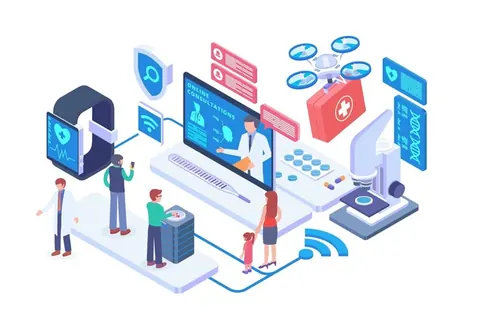
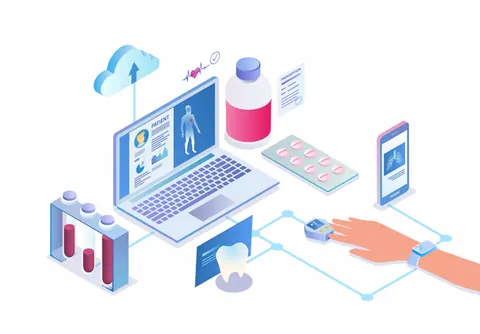
- Devices and sensors: a blood pressure monitor at home, a bedside monitor, an asset tag on an infusion pump or a temperature probe in a vaccine fridge.
- Connectivity: Wi-Fi, Bluetooth, mobile data or a dedicated low-power network, often through a gateway or a smartphone app.
- A platform: software, usually in the cloud, that stores the data, applies rules and raises alerts.
- The people and systems that act on it: a nurse’s dashboard, a doctor’s phone, the hospital information system (HIS) or the electronic health record (EHR).
You will also see the term Internet of Medical Things (IoMT), which simply narrows IoT to devices with a medical purpose. For how these pieces fit with the rest of hospital software, see our guide to the components of a health information system.
Benefits of IoT in healthcare
- Continuous monitoring and earlier warning: connected monitors record vital signs around the clock instead of at set rounds, so a gradual deterioration shows up as a trend and can trigger an alert before it becomes an emergency.
- Care at home for long-term conditions: patients with conditions such as hypertension, diabetes or heart failure can send readings from home, and the care team reviews them remotely and calls in those who need attention.
- Fewer manual recording errors: readings that flow straight into the record avoid transcription mistakes and free nursing time spent charting.
- Better use of equipment: tagged equipment can be found quickly, its usage measured and its maintenance scheduled, which reduces time lost searching and helps decide whether to buy more.
- Safer medicines, vaccines and blood: temperature sensors in refrigerators and cold rooms raise alerts on excursions and keep a continuous log, rather than relying on periodic manual readings.
- Safer, smoother operations: sensors can track conditions in operation theatres and ICUs, bed occupancy and the movement of patients and staff, helping managers spot bottlenecks.
- Better data for decisions: device data, combined with clinical records, supports audits, quality indicators and research, and feeds many AI applications in healthcare.
Where IoT is used in healthcare
Remote patient monitoring
Connected blood pressure monitors, glucometers, pulse oximeters and ECG patches send readings to a care team, which reviews them against agreed thresholds. Common uses include follow-up after discharge, chronic disease programmes and monitoring during home care. It works best when the programme is clear about who watches the data, how quickly, and what happens when a reading is abnormal.
Connected devices in the hospital
Bedside monitors, infusion pumps, ventilators and smart beds increasingly connect to central stations and to the EHR. Benefits include central viewing of many patients, automatic charting of vital signs and alerts such as a patient leaving a bed. Our article on uses of computers in hospitals covers the wider systems these devices feed.
Asset tracking and equipment management
RFID or Bluetooth tags on wheelchairs, pumps, monitors and other mobile equipment show where each item is and how often it is used. Linked to maintenance software, the same data supports NABH’s medical equipment standard (FMS.5 in the 6th edition), which expects an equipment inventory with logs, periodic inspection and calibration, and monitoring of downtime for critical equipment.
Cold-chain and environmental monitoring
Wireless sensors in pharmacy, vaccine and blood bank refrigerators record temperature continuously and alert staff when it drifts out of range. NABH’s 6th edition expects medications, including vaccines, to be stored according to manufacturers’ recommendations (MOM.3), and a continuous record makes that easy to demonstrate. At national scale, India’s Electronic Vaccine Intelligence Network (eVIN), run under the National Health Mission, uses electronic temperature loggers on vaccine cold chain equipment alongside real-time stock data. The same approach applies to temperature, humidity and air quality in operation theatres and ICUs.
Disadvantages and challenges of IoT in healthcare
Cybersecurity risk
Every connected device is a possible way into the hospital network. Common weaknesses include default passwords, software that is never patched, unencrypted data and devices that stay on the network long after the vendor stops supporting them. An attack can expose patient data or, worse, disrupt devices used in care.
Devices that do not work together
Devices from different makers use different formats and platforms, so data often ends up in separate dashboards that do not reach the patient record. Integration with the HIS or EHR can cost as much effort as the devices themselves. Standards help: India’s Ayushman Bharat Digital Mission (ABDM) exchanges health records using the HL7 FHIR standard, so ask vendors how their data reaches your systems.
Cost and infrastructure
Beyond the devices, you pay for network coverage across the building, platform subscriptions, integration, maintenance, replacement batteries and staff training. Smaller hospitals may struggle to justify the spend unless the use case is specific and measurable.
Alarm overload and data overload
More data does not automatically mean better care. Poorly set thresholds generate frequent false alarms, and staff who receive too many alerts start to ignore them. Someone also has to review remote readings, which is new work that needs staffing and clear responsibility.
Reliability and accuracy
Connections drop, batteries run out and sensors drift. Consumer wearables may not be validated for clinical decisions, and some patients find home devices hard to use. Clinical teams need to know how far they can trust each reading and what to do when data stops arriving.
Privacy and data protection
Connected devices collect sensitive information continuously, sometimes from patients’ homes. Under the Digital Personal Data Protection Act, 2023, the hospital remains responsible for that data even when a device vendor’s cloud processes it, as the next section explains.
IoT in healthcare: the rules that apply in India
- Medical Devices Rules, 2017: all medical devices in India are regulated under the Drugs and Cosmetics Act, 1940 and these rules, with the Central Drugs Standard Control Organisation (CDSCO) as the central regulator. The definition covers software and accessories intended for purposes such as diagnosis, monitoring or treatment, and devices are classed by risk from Class A (low) to Class D (high). Licensing became mandatory for Class A and B devices from 1 October 2022 and for Class C and D from 1 October 2023; non-sterile, non-measuring Class A devices need registration instead of a licence.
- Connected apps and platforms: CDSCO’s guidance on medical device software gives examples of regulated software, including an app that reads a Bluetooth blood pressure cuff to track blood pressure for medical purposes, and an IoT platform that works with connected glucometers to track chronic conditions. Software meant only for general wellness or fitness tracking is outside the rules, but software that measures or reports physiological values for screening, diagnosis, monitoring or alerting is not treated as wellness software.
- Digital Personal Data Protection Act, 2023: the hospital, as Data Fiduciary, must give patients a clear notice, use the data only for the stated purpose and take reasonable security safeguards. The Digital Personal Data Protection Rules, 2025 set minimum safeguards, including encryption or masking, access control, logging and monitoring, backups, and keeping logs for one year. Breaches must be reported to affected people and the Data Protection Board. The rules were notified in November 2025, and most obligations apply from May 2027.
- CERT-In reporting: the CERT-In directions of 28 April 2022 require service providers, intermediaries, data centres, body corporates and government organisations to report specified cyber incidents to CERT-In within 6 hours of noticing them. The list explicitly includes attacks on IoT devices and associated systems, and logs of all ICT systems must be kept for a rolling 180 days within India.
- NABH standards: for accredited hospitals, connected devices also fall under the equipment management standard (FMS.5) and the standard on confidentiality, integrity and security of records, data and information (IMS.5).
Our overview of who regulates healthcare in India explains where CDSCO and the other bodies fit, and our guide to health data retention policies in India covers how long to keep records.
How to introduce IoT in a hospital safely
- Start with a specific problem, such as missing equipment, fridge temperature breaches or readmissions in one patient group, and decide how you will measure improvement.
- Check regulatory status: for anything with a medical purpose, ask for the vendor’s licence or registration under the Medical Devices Rules, 2017 and the device’s risk class.
- Write security into the purchase: no default passwords, encryption in transit and at rest, a patching commitment, a stated support end date, and help putting devices on a separate network segment.
- Plan integration with the HIS or EHR before buying, so data does not stay in a separate dashboard.
- Design the alerts with the clinical team: who receives them, the thresholds and the response time.
- Cover data protection: a clear notice to patients, only the data the programme needs, a defined retention period and a data processing contract with the vendor.
- Pilot, review and then scale, keeping device inventory, maintenance and decommissioning in your equipment management programme.
Technology is one part of patient safety in hospitals; connected devices work best when they support clear processes rather than replace them.
Frequently Asked Questions
Is a fitness band a medical device in India?
Not if it is intended only for general wellness or fitness tracking. Whether a product is a medical device depends on the manufacturer’s intended use, and CDSCO’s guidance on medical device software places general wellness software outside the Medical Devices Rules, 2017. A wearable or app intended to measure physiological values for screening, diagnosis, monitoring or alerting is not treated as wellness software and can be regulated as a medical device.
Do hospitals need patient consent for remote monitoring data?
Usually the hospital relies on the patient’s consent, given after a clear notice explaining what data is collected and why. The DPDP Act also allows some processing without consent, for example data a person voluntarily provides for a specified purpose, or responding to a medical emergency that threatens life or health. Confirm the legal basis for each programme with your legal adviser.
What should a hospital do if a connected device is hacked?
Isolate the device, follow your incident response plan and report the incident to CERT-In within 6 hours of noticing it, as CERT-In’s 2022 directions require. If personal data is affected, the DPDP Rules also require informing affected individuals and the Data Protection Board, with a detailed report to the Board within 72 hours.
What is the difference between IoT and IoMT?
IoT covers any connected device, from building sensors to asset tags. The Internet of Medical Things (IoMT) is the subset with a medical purpose, such as connected monitors, infusion pumps and remote monitoring devices. In a hospital, both matter: IoMT devices raise clinical and regulatory questions, while all connected devices raise security ones.
Can a small hospital or clinic benefit from IoT?
Yes, if it starts with a focused use. Wireless temperature monitoring for medicine and vaccine fridges, or tags on a few high-value devices, are relatively simple to set up and easy to measure. Larger programmes such as remote monitoring need staff time to review data, so plan for that before buying devices.
Filed under Hospital Technology · First published